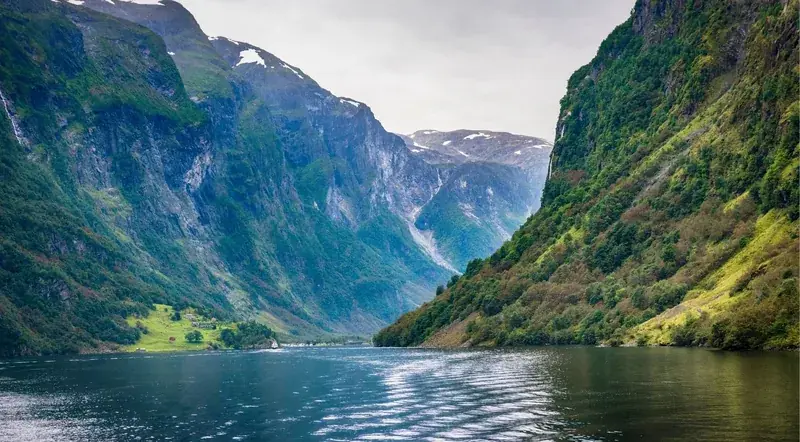
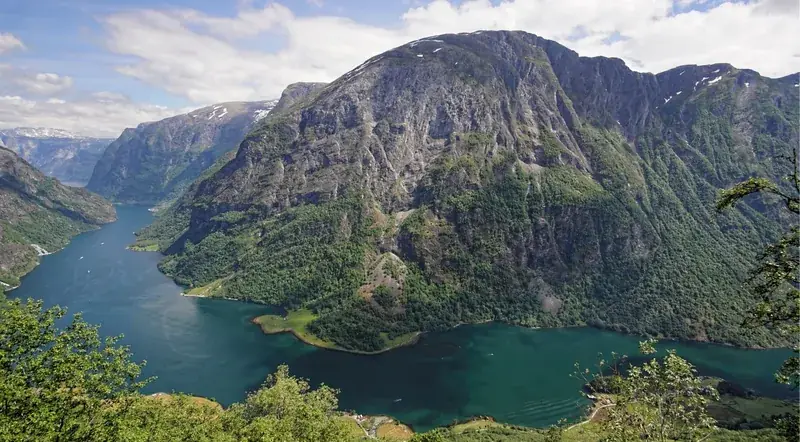
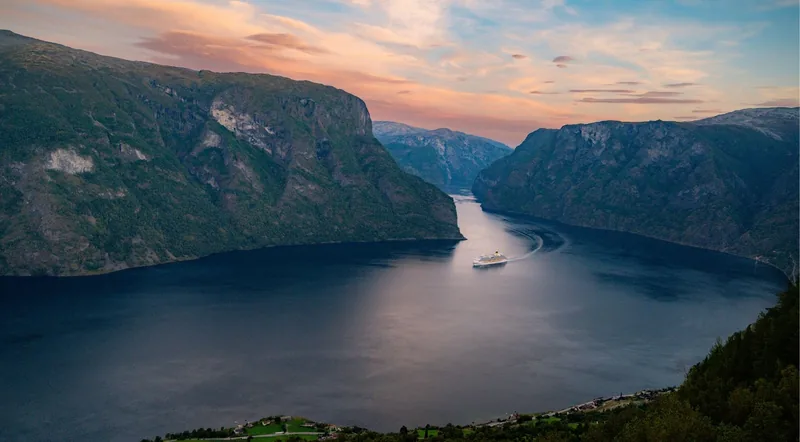
There's a moment on most Norwegian fjords cruises that stays with you. For many travellers it comes rounding a bend on the Nærøyfjord, when the walls suddenly squeeze in to barely 250 metres apart, waterfalls streaking down rock faces over 1,700 metres high, and the only sound is water lapping the hull of an electric boat gliding silently through it all. That, right there, is why people fall in love with the Norwegian fjords, and why a fjord cruise belongs near the top of any Norway itinerary.
If you're planning Norwegian fjord cruises for the 2026 season, this is your complete, no-nonsense guide: what makes these fjords so special, which ones to see, how to choose between large-ship and small-ship cruises, the best cruise lines and operators, and tips for first-timers and families.
TL;DR
- The Norwegian fjords are the world's gold standard, Geirangerfjord and Nærøyfjord are UNESCO World Heritage Sites, and the region holds the King (Sognefjord) and Queen (Hardangerfjord) of fjords; the best way to experience them is from the water.
- Match the ship to the experience, small-ship and day cruises (like Bergen's Mostraumen trip and the electric Flåm–Gudvangen Nærøyfjord cruise) sail deep into narrow fjords big liners can't reach, while big-ship lines (P&O, MSC, Princess, Celebrity, NCL) offer affordable, family-friendly comfort.
- 2026 is a landmark year, Norway's zero-emission rules took effect on 1 January 2026 for smaller vessels in the UNESCO fjords, Bergen now requires shore power, and Viking Libra, the world's first hydrogen-powered cruise ship, arrives.
What makes the Norwegian fjords so special
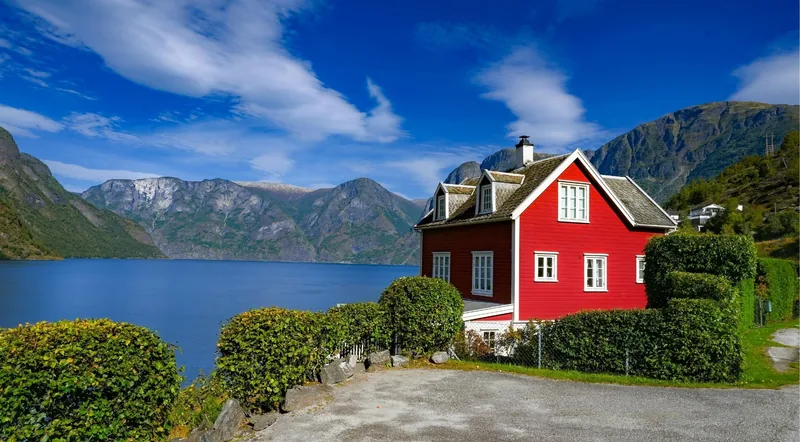
A fjord — the word itself is Norwegian — is a long, deep inlet of the sea between high cliffs, formed where a glaciated valley sank below sea level. What sets Norway's apart isn't just scale but the living landscape: tiny farms cling to impossible ledges, goats graze on near-vertical slopes, and red-roofed villages have sheltered in the same coves for centuries. UNESCO inscribed the West Norwegian Fjords — Geirangerfjord and Nærøyfjord — in 2005, and they remain Norway's only natural World Heritage site.
The geology is genuinely a "natural history laboratory." Waterfalls tumble from hanging valleys, glaciers like Jostedalsbreen (mainland Europe's largest, at 487 square kilometres) feed the system, and the deep fjord water stays remarkably cold and stable year-round. The result is scenery that feels almost unreal, which is exactly why the village of Undredal on the Aurlandsfjord is said to have helped inspire the kingdom of Arendelle in Disney's Frozen.
Other Norway Experiences You Might Also Like
More of Norway to explore, the Flåm Railway, Nærøyfjord and Geirangerfjord cruises, the Northern Lights and whale watching in Tromsø, the Lofoten Islands, Oslo city tours and Stavanger’s Pulpit Rock (Preikestolen) hike.
The main fjords you'll visit
Sognefjord, the King of the Fjords. At 205 kilometres long and up to 1,308 metres deep, Sognefjord is Norway's longest and deepest, and the second-longest in the world after Greenland's Scoresby Sund. It branches into spectacular arms and reaches inland almost to the Jotunheimen mountains.
Nærøyfjord, the narrow jewel. This UNESCO-listed arm of the Sognefjord narrows to about 250 metres at its tightest, hemmed by steep mountains rising to around 1,761 metres. The 2-hour Flåm–Gudvangen cruise here is, for many, the single most beautiful boat trip in Norway.
Hardangerfjord — the Queen of the Fjords. Norway's second-longest at 179 kilometres, Hardangerfjord is orchard country: in spring, apple, cherry and pear blossoms blanket the slopes; in autumn, you taste the cider. It's also the gateway to the Trolltunga hike and the thundering 182-metre Vøringsfossen waterfall.
Geirangerfjord — the crown jewel. This 15-kilometre UNESCO branch is the most photographed fjord in Norway, famous for the Seven Sisters waterfall — seven streams plunging some 250 metres down a sheer cliff — and the rival "Suitor" falls opposite.
Mostraumen — Bergen's secret half-day fjord. Up the 27-kilometre Osterfjord from Bergen lies the narrow Mostraumen strait, so tight that big cruise ships can't reach it — making this the perfect taste of wild Norway if you only have half a day in port.
Types of cruise experience
Large-ship cruises are the affordable, do-everything option. Lines like P&O Cruises, MSC, Princess, Royal Caribbean and Celebrity sail week-long-plus itineraries calling at Bergen, Ålesund, Stavanger, Olden, Flåm and more. You get pools, kids' clubs, multiple restaurants and balcony cabins, but the biggest ships can't enter the narrowest fjords.
Small-ship cruises are where the fjords come alive. Carrying anywhere from around 100 to a few hundred guests, lines such as Windstar, Seabourn, Ponant, Hurtigruten and Havila linger longer, sail deeper, and reach inlets the megaships sail past.
Day cruises from Bergen and Flåm are the budget-friendly, flexible way to sample the fjords without committing to a multi-day sailing. The Mostraumen cruise from Bergen and the electric Nærøyfjord cruise from Flåm are the two standouts.
Coastal voyages are a category all their own. Hurtigruten (sailing since 1893) and Havila Voyages run the legendary Bergen–Kirkenes Coastal Express, calling at 34 ports each way over a 12-day round trip.
Best cruise lines and operators for 2025–2026
- Hurtigruten & Havila: the coastal-voyage specialists. Havila's four ships are LNG-battery hybrids able to cross the UNESCO fjords with zero emissions.
- Viking: adults-only (no under-18s), small-ish ocean ships under 1,000 guests, all-veranda staterooms, no casinos.
- Windstar: yacht-style small ships (224–342 guests) with open decks made for scenic days.
- Seabourn & Ponant: luxury and expedition-style small ships.
- P&O, MSC, Princess, Celebrity, Royal Caribbean, NCL: the mainstream big-ship lines, best for families, value and onboard amenities.
What to expect onboard and overboard
Expect scenery that genuinely stops conversation: glassy water, waterfalls everywhere, snow-streaked peaks even in July, and storybook wooden villages. Wildlife is a bonus rather than a guarantee — look for white-tailed eagles, Atlantic puffins, harbour seals, harbour porpoises and occasionally minke whales. And don't underestimate the midnight sun: from late May through late July above the Arctic Circle, the sun simply never sets.
When to go
The Norwegian fjords cruise season runs May through September. May is the sleeper pick: snowmelt makes waterfalls thunder at maximum volume, fruit trees blossom in Hardanger, crowds are thin and prices lower. June and July bring the midnight sun, the warmest, longest days, and peak demand. September–October delivers autumn colour and quieter ports, with more rain and a chance of early northern lights. Winter cruising continues year-round on the coastal voyages, prized for the aurora. For a full breakdown, see our month-by-month guide to the best time to cruise.
How Bergen fits in
Bergen is the gateway to the fjords — Norway's busiest cruise port and the natural hub for western-fjord trips. From the cruise terminals, you're minutes from UNESCO-listed Bryggen, the Fløibanen funicular up Mount Fløyen, the buzzing Fish Market, and composer Edvard Grieg's home, Troldhaugen. For everything bookable from the city, see our guide to Bergen fjord cruises: day trips, tours & how to book.
Why small ships beat big ones for the fjords
Three reasons. First, access: narrow straits like Mostraumen and protected fjords like Nærøyfjord are simply off-limits to large vessels. Second, intimacy: on a 200-guest ship you reach villages a bigger ship cannot reach. Third, regulation: Geiranger and Flåm are tightening access for diesel-powered ships, and the cleanest small and electric vessels keep full access.
The big 2026 story: cleaner, quieter fjords
2026 is genuinely a turning point. On 1 January 2026, Norway's zero-emission requirement took effect for passenger ships and ferries under 10,000 gross tons in the five UNESCO World Heritage fjords. For larger ships, the requirement applies from 1 January 2032. The most exciting symbol of the shift is Viking Libra, the world's first hydrogen-powered cruise ship, with delivery scheduled for late 2026.
Recommendations
First time, value and ease: Book a 7-night big-ship cruise (P&O, MSC, Princess or Celebrity) that explicitly docks at Geiranger and Flåm. Add an independent RIB or boat tour at Geiranger to actually reach the Seven Sisters.
The real, deep-fjord experience: Choose a small ship (Windstar, Seabourn, Ponant) or a Hurtigruten/Havila coastal voyage.
Only a day in Bergen or Flåm: Take the 3.5-hour Mostraumen cruise from Bergen, or the 2-hour electric Nærøyfjord cruise between Flåm and Gudvangen. Pre-book in summer — they sell out.
Families: Pick NCL, MSC or P&O for onboard kids' facilities. Avoid adults-only Viking.
Booking timing: Book 9–12 months ahead for the best cabins and early-bird pricing, especially for June–July midnight-sun sailings and smaller ships. Splurge on a balcony — you'll want the views from your own private space. On a tight budget, see our guide to cheap fjord cruises and the best 2026 deals.
Caveats. Weather is the wild card — western Norway is one of the wettest regions in the world, so pack layers and a waterproof shell. "Scenic cruising" isn't the same as docking: some large ships list Geirangerfjord as a "sail by" without entering the scenic inner section, so read itineraries carefully. Waterfall volume drops through summer (fullest in May–June from snowmelt), wildlife is never guaranteed, and Norway is expensive — booking directly with local operators often saves money and means smaller groups.