The question of which side of the ship to book is one of the most-searched pieces of pre-cruise planning advice for Norway, and one of the most frequently answered incorrectly. The correct answer depends almost entirely on which fjord you are sailing, because the geometry of each route is different. For fjord cruises from Bergen, most routes are dead-end sailings where the ship sails in and reverses back out, which neutralises any cabin-side advantage over the full trip.
The three rules that cover most situations
- Open deck beats any cabin side on every dead-end fjord (Geiranger, Nærøyfjord, Trollfjord, Lysefjord). The ship reverses out, swapping sides, so a fixed balcony sees half the show. Get outside.
- Geirangerfjord: PORT inbound for the Seven Sisters waterfall. One widely-shared source says starboard. That is wrong. Geography and route guides confirm the Seven Sisters are on the north bank, which is to your left (port) when heading east toward Geiranger village.
- Hurtigruten: neither side is definitively correct. Two legitimate rules circulate and they optimise different things. Open outer decks are the consistently right answer.
Other Experiences You Might Enjoy
If you're planning a Norwegian fjords cruise, look at what's on offer beyond your core route. The Nærøyfjord and Geirangerfjord are the two UNESCO-listed fjords, both remarkable from the water. From Bergen you can reach the Sognefjord (Norway's longest) with a day trip to Flåm or Balestrand, sail the Hardangerfjord to Rosendal, or take a short half-day to the Mostraumen strait up the Osterfjord. Further afield, the Lysefjord near Stavanger offers cruises directly beneath Preikestolen (Pulpit Rock), and Hurtigruten's coastal express connects Bergen to the Arctic via Lofoten and Trollfjord.
The rule that beats all others: get on the open deck
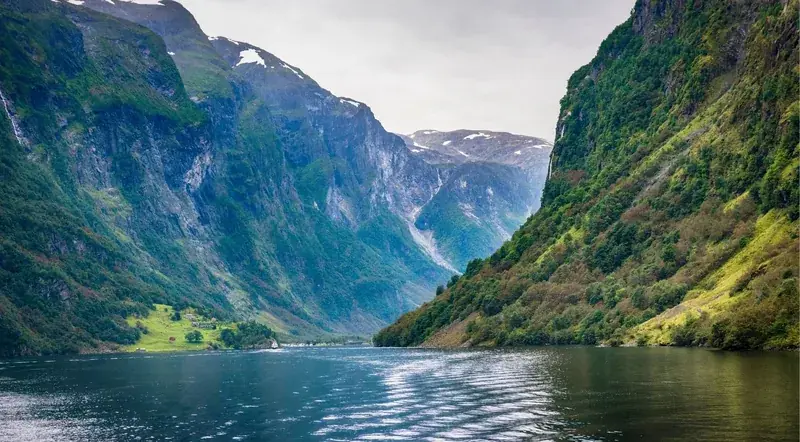
The single most useful piece of advice for Norwegian fjord cruises applies everywhere: the bow and the open outer decks give you a wider, more dramatic view than any single-side cabin or balcony. This is especially true on the compact, deep fjords — Nærøyfjord, Geirangerfjord, Trollfjord — where the walls rise steeply on both sides simultaneously and the scenery is best appreciated looking forward into the narrowing canyon rather than laterally from a balcony.
It matters most on dead-end fjords. Every major scenic fjord in Norway that cruise ships enter — Geiranger, Nærøyfjord, Trollfjord, Lysefjord, Hjørundfjord — is a dead end. The ship sails in, turns or reverses, and sails back out along the same route. Whatever was to your port on the way in is to your starboard on the way out. Over the full transit, both sides see both banks. The only thing that moves the dial in favour of one side is if a specific, named landmark sits permanently on one bank, and even then, you'll see it from the other side on the return leg.
Geirangerfjord, the one fjord where side genuinely matters (port inbound)
Geirangerfjord is the exception that proves the rule. It has two fixed, named landmarks on opposite banks — the Seven Sisters on the north shore and the Suitor (Friaren) on the south shore — and they never swap sides relative to the landscape.
When sailing inbound toward Geiranger village (whether entering from the Ålesund/Storfjorden approach or from Hellesylt, heading roughly east): the north bank is to your left (port). The Seven Sisters — seven streams tumbling together down a sheer face in a cascade around 250 metres high — are on the north bank. PORT is the recommended side inbound. Starboard faces the Suitor, the single responding waterfall on the south bank, and the Knivsflå farm.
Because the ship reverses back out of the dead-end fjord, the Seven Sisters become starboard on the exit leg. Over the round trip, both sides see both waterfalls. If forced to choose a cabin, pick port for the inbound iconic view. But be on the open deck for both legs, from the outside you see the whole panorama of cliffs closing in and both waterfalls at once.
A note on a circulating error: a popular cruise planning site states that the Seven Sisters are best seen from starboard when entering. This contradicts the fixed geography of the fjord and detailed coastal route guides. Trust port-inbound.
Nærøyfjord and Aurlandsfjord, the bow wins, every time
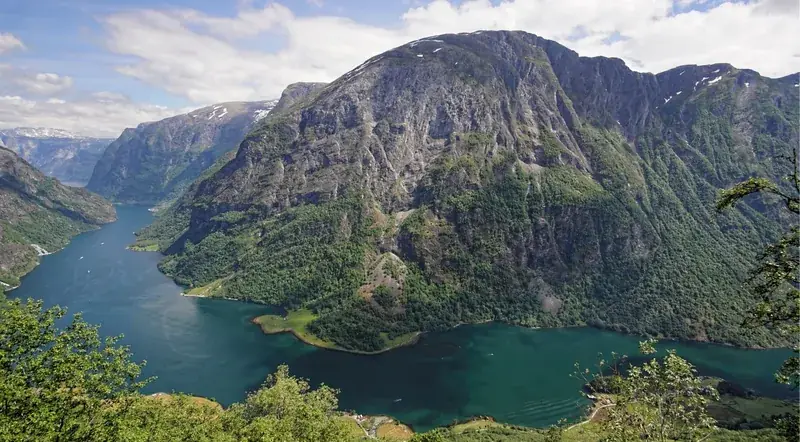
The Nærøyfjord is so narrow — about 250 metres at its tightest, near the hamlet of Bakka — that both walls fill your view from almost any position on the boat. There is no "wrong side." One guide singles out the port side for the Flåm-to-Gudvangen direction; the operators themselves and multiple local guides say direction and side make little difference here. The only real priority is getting an outdoor spot on the deck or at the bow before they fill up, arrive early.
The Aurlandsfjord, which you sail first on the Flåm–Gudvangen cruise before turning into the Nærøyfjord, is wider and sunnier. For large cruise ships making the approach to Flåm, the starboard side has a modest edge inbound (for the village of Undredal, roughly 30 minutes from Flåm), with port recommended for the sailaway evening light. But on the small electric boats operated by The Fjords and Lustrabaatane, outdoor seating at the bow is the priority over any cabin side.
Hurtigruten coastal voyage, the genuinely contested debate
This is where the port/starboard question gets most heated, and where online advice is most contradictory. Two legitimate rules exist, and they answer different questions.
Rule 1: Port northbound / Starboard southbound. This is the most-repeated guide advice. It reflects the fact that Hurtigruten ships typically berth port-side to the quay, so the port side faces the town approaches, village landings and coastal scenery. Multiple cruise travel writers and the majority of passenger accounts online support this framing.
Rule 2: Starboard northbound / Port southbound. This is the geographic-logic view, sometimes expressed as the SNPS mnemonic (Starboard North, Port South). Norway's mainland sits to the east, so when sailing north the land mass is broadly to starboard. This view says starboard gives better mountain and open-mainland views.
Here is the resolution: they're both right about different things. Port northbound faces the town quays and village approaches. Starboard northbound faces the open mainland mountains. The Hurtigruten's inshore route among the islands also puts scenery on both sides constantly, the ship changes heading so frequently that any fixed-side advantage evaporates within the hour. The timetable is deliberately arranged so scenery seen in daylight northbound is largely passed at night southbound, and vice versa. Choosing your direction (northbound vs. southbound) matters more than choosing your side. Then use the open outer decks and panorama lounge once aboard.
One practical note: starboard cabins are quieter on most Hurtigruten sailings, away from the gangway, cargo ramp and port-side operations at each stop.
For the Geirangerfjord detour (northbound, summer only): follow the Geiranger rule above, port inbound for the Seven Sisters. For the Trollfjord detour (southbound, summer only): the ship enters bow-first, executes a full 180-degree turn at the head, and exits bow-first. Open deck at the bow for the narrow entrance; both walls are equally dramatic and the turn makes cabin side irrelevant.
Hardangerfjord and Eidfjord, both sides, no strong preference
The Hardangerfjord is wide and pastoral, fruit orchards, cider farms, waterfalls and modest fjord villages line both shores with roughly equal appeal. No source gives a hard port/starboard recommendation and none is needed: the scenery is symmetrical enough that the open deck beats any single-side balcony here too. The most dramatic section is the final approach into the inner Eidfjorden arm, where both banks close in steeply just before the pier.
One important note: Vøringsfossen (the famous 182-metre waterfall) is not visible from the ship. It is a 25-minute drive inland up the Måbødalen canyon from the town of Eidfjord, reached only on excursion. If Vøringsfossen is your priority, book a shore excursion or hire a car, no amount of cabin-side optimisation will put it in view from the water.
Lysefjord and Preikestolen — small boats, open decks, no bad seat
The tour boats that cruise the Lysefjord from Stavanger — Rødne's electric catamarans and Brim Explorer's hybrid vessels — are small, manoeuvrable craft with heated cabins and large open sun decks. The captain slows, circles and holds position at each highlight, including a roughly 10-minute pause below Preikestolen (Pulpit Rock) and a bow-in push toward the Hengjanefossen waterfall. Side choice is essentially irrelevant — passengers move freely between the outdoor decks throughout.
The Lysefjord is an out-and-back cruise (about 3–3.5 hours from Stavanger), so both walls get equal attention on the return leg regardless of where you start.
Sognefjord and the Flåm approach by large cruise ship
For large ocean cruise ships approaching Flåm via the Sognefjord and Aurlandsfjord: the starboard side has a modest advantage inbound, primarily for the village of Undredal (its stave church, goat cheese farms and red boathouses visible on the right bank about 30 minutes before Flåm). The port side is recommended for the evening sailaway view as the ship heads back toward the open sea. Neither advantage is dramatic enough to override the "open deck is better" logic for the scenic inner sections.
On the express and day-trip boats (Norled Bergen–Flåm, Lustrabaatane, Norway in a Nutshell), the outdoor deck and bow remain the definitive best seats regardless of side. See our Bergen fjord cruises: day trips and how to book guide for the full range of Sognefjord options.
When cabin side does genuinely matter
Most of the time, it doesn't. But there are three situations where the recommendation holds up regardless of turnaround or deck position:
- Geirangerfjord inbound. If you have a balcony and want the Seven Sisters straight off the rail without competing for open-deck space at the prime moment — port is the right call.
- Trollfjord. Starboard on entry gives the slightly more photogenic first-look at the cliffs as the bow threads the 100-metre entrance. The 180-degree turn neutralises it over the full transit, but the entry moment is the money shot.
- Olden (Nordfjord). Ships tend to berth with a consistent orientation at the deep-water pier; starboard is cited as the better sailaway view. Confirm your specific ship's docking side with the line before booking.
Two myths worth correcting
Myth 1: "Sit on the right side for the best views at Åndalsnes." This advice refers to seating on the Rauma Railway train excursion through Romsdalen, not to which cabin side to book on your cruise ship. The two are routinely conflated online. From the ship on the Romsdalsfjord, both banks are equally scenic, and the famous landmarks (Trollveggen, Romsdalshorn, Romsdalseggen) are inland up the valley and not visible from the water at all.
Myth 2: The SNPS rule is definitive for Hurtigruten. SNPS (Starboard North, Port South) is presented in some guides as a settled fact. It is one valid framework for one set of priorities — open-mainland views — and directly contradicts the equally valid port-north rule that optimises for coastal-town and quay views. Neither is wrong; neither covers everything. See the Hurtigruten section above.
A note on planning. Every cruise line is different. Ships rotate in front of key viewpoints on some sailings so all passengers get a turn. Verify your specific ship's approach and docking orientation with the operator before booking a cabin specifically for the view — the information here reflects the typical pattern but cannot account for individual ship and route variations.